
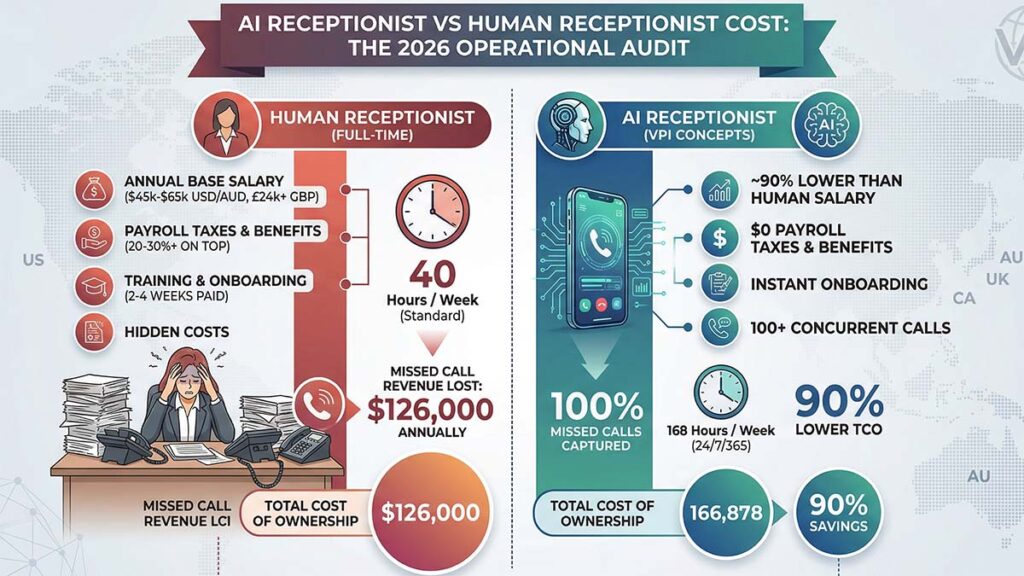
AI Receptionist vs Human Receptionist Cost analysis is the single most important metric for any small business looking to survive the $126,000 revenue leak caused by missed calls. Let’s start with a hard financial reality: according to data from ****, that is the average annual revenue lost by a small business in the US, UK, Australia, or Canada that misses just 2–3 high-intent calls per day. Whether you are running a 5-person service team or a solo professional firm, the traditional front-desk model is no longer a “safe” bet. It is a financial bottleneck.
When analyzing the AI Receptionist vs Human Receptionist Cost, the data reveals a massive gap in efficiency. This report provides a direct comparison focusing on the cold, hard reality of labor expenses, 24/7/365 coverage, and the missed-call revenue penalty.
1. The 2026 Cost Audit: A Head-to-Head Comparison
To understand the true AI Receptionist vs Human Receptionist Cost, you must account for the “Total Cost of Ownership” (TCO), including benefits, taxes, training, and turnover. For most businesses, the AI Receptionist vs Human Receptionist Cost is determined by more than just a base salary.
| Expense Category | Human Receptionist (Full-time) | Automated Receptionist |
| Annual Base Salary | $45k–$65k (USD/AUD) / £24k+ (GBP) | ~90% lower than human salary |
| Payroll Taxes & Benefits | +20–30% on top of base | $0 |
| Training & Onboarding | 2–4 Weeks (Paid) | Instant (Pre-configured logic) |
| Availability | 40 Hours / Week (Standard) | 168 Hours / Week (24/7/365) |
| Scalability | 1 Call at a time | 100+ Concurrent Calls |
In high-income markets, a human receptionist is a significant fixed cost. For repetitive tasks like high-volume intake and routine lead qualification, they represent an over-qualified solution for a logical, systematic problem. As reported by Forbes, automating these roles is now a baseline requirement for maintaining competitive margins in 2026.
2. Scaling the Surge: Handling 100 Calls with Precision
One of the most common “breaking points” for a growing business is the simultaneous call. If three high-value leads call at 10:00 AM on a Monday, the traditional model fails. Two leads go to hold or voicemail, and research from Harvard Business Review indicates that 80% of callers will not leave a message; they simply call the next listing on Google.
By optimizing your AI Receptionist vs Human Receptionist Cost structure to allow for unlimited concurrent calls, you move your “Missed Call Rate” to 0%. You aren’t just saving money; you are capturing revenue that was previously leaking out of your business because the AI Receptionist vs Human Receptionist Cost is far easier to scale.
3. The “Silent Drain” of Traditional Phone Systems
Traditional phone systems require manual human intervention to function, creating three hidden costs that increase the overall AI Receptionist vs Human Receptionist Cost:
- The Context Switch: Every time a billable staff member stops to answer a routine call, it takes an average of 23 minutes to regain deep focus.
- The Information Gap: Human receptionists take notes that must be manually entered; automated systems create data that syncs instantly.
- The After-Hours Gap: If your business “closes” at 5:00 PM, you lose the 40% of consumers who shop for services in the evening.
For specialized industry advice, check our guide on AI Medical Receptionist Growth Strategies.
4. The Data Advantage: Seamless Database Integration
The real winner in the AI Receptionist vs Human Receptionist Cost debate is defined by what happens after the call. A sophisticated automated system acts as a real-time data bridge. It extracts the caller’s intent, lead score, and contact details, and pushes them directly into your existing lead management system or client database.
This level of speed and technical accuracy is impossible for a human staff member to replicate manually, especially during high-volume periods where the AI Receptionist vs Human Receptionist Cost becomes an even more obvious choice. You can see how this applies to legal practitioners in our Law Firm Growth Guide.
5. Frequently Asked Questions (FAQ)
Q: Does the AI Receptionist vs Human Receptionist Cost include setup?
A: Most professional automated systems involve a one-time configuration fee, which is significantly lower than the cost of recruiting and training a new employee.
Q: Is it secure for global data laws?
A: Yes. Modern systems use encrypted tunnels to pass data directly into your secure business ecosystem, ensuring compliance across the US, UK, AU, and CA.
