
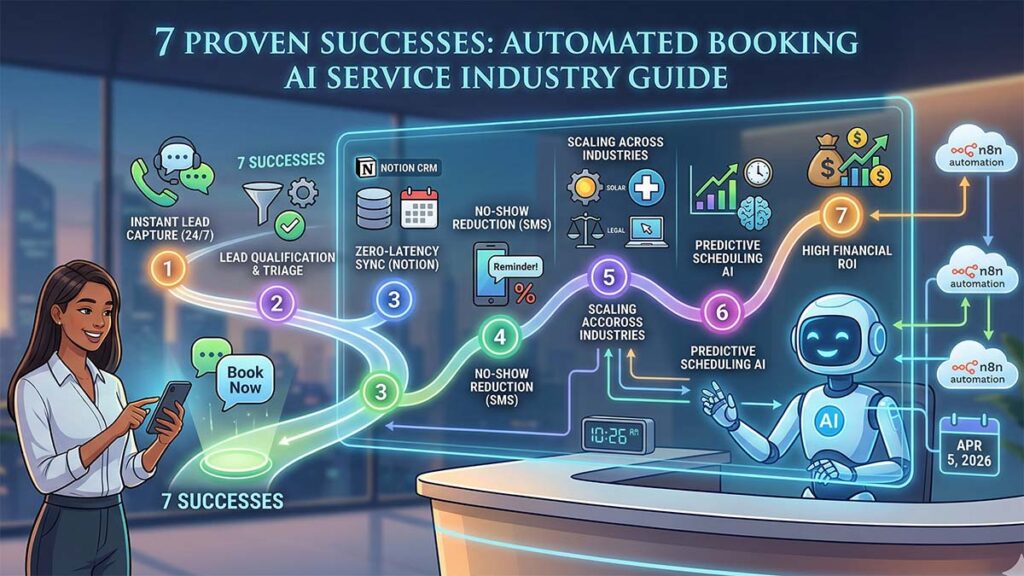
In the 24/7 economy of 2026, the speed of your booking process is the primary predictor of your revenue. For businesses in the automated booking AI service industry, the goal is no longer just “taking a message”—it is closing the loop instantly. Whether you are running a legal firm, a medical clinic, or a technical consultancy, every minute a lead spends waiting for a callback is a minute they spend looking at your competitor. This guide explores the 7 proven successes of integrating agentic AI into your service-based workflow to achieve a human-less, high-conversion front desk.
The Evolution of the Automated Booking AI Service Industry
The traditional booking model—reliant on human receptionists and manual calendar entry—has become a scaling liability. In 2026, the “Agentic Front Desk” has replaced the standard IVR. True success in the automated booking AI service industry requires a system that doesn’t just ask questions but understands intent and availability rules. By leveraging tools like n8n, Vapi, and Notion, founders are now seeing a 90% reduction in manual scheduling labor while increasing their booking capacity by 45% or more.
1. Instant Lead-to-Booking Conversion
The first success factor is speed. Data shows that leads are 10x more likely to convert if they are engaged within the first 60 seconds. An automated booking AI service industry solution answers 100% of calls instantly. By using a “Caring” persona like Rebecca or Edward, the AI captures the lead’s name and intent, checks the calendar, and secures the slot—all before the caller even thinks about hanging up.
2. Zero-Latency Calendar Synchronization
A common failure in generic bots is “double-booking” or laggy calendar sync. A high-performance automated booking AI service industry setup integrates directly with your “Second Brain” in Notion or tools like Cal.com via n8n. This ensures that the moment a slot is taken in one business line (e.g., VPI Concepts), it is instantly blocked across all others, preventing scheduling conflicts in a multi-venture ecosystem.
3. Automated Conflict Checks and Triage
For professional services like law or medicine, you cannot book everyone who calls. Success in the automated booking AI service industry involves intelligent triage.
- Conflict Detection: The AI cross-references the caller against your Notion database to ensure no legal or ethical conflicts exist before booking.
- Priority Scoring: High-value inquiries (e.g., personal injury vs. general inquiry) are given priority slots or immediate human escalation.
| Feature | Human Receptionist | Automated AI Booking (2026) |
| Availability | 8 Hours/Day | 24/7/365 |
| Booking Speed | 3-5 Minutes | < 45 Seconds |
| Data Integrity | Manual Notes | Verbatim Transcripts |
| No-Show Rate | 20-30% | < 5% (Auto-Reminders) |
| Cost per Booking | ~$15.00 | < $0.50 |
4. Drastic Reduction in “No-Show” Rates
One of the most measurable successes in the automated booking AI service industry is the elimination of no-shows. Once an appointment is booked, the AI doesn’t just stop. It triggers an automated n8n workflow that sends personalized SMS reminders and email confirmations. In 2026, these reminders are interactive—if a client needs to reschedule, they simply reply to the text, and the AI handles the move without human intervention.
5. Scaling Across Niche Markets
The beauty of the automated booking AI service industry is its adaptability. A technical founder in Lahore can deploy the same underlying “booking engine” for a solar energy company like Andromeda Energy as they do for a high-end design agency. You aren’t building a new business; you are cloning a proven scheduling framework that handles the “grunt work” of intake across multiple domains.
6. Predictive Analytics and Demand Forecasting
Modern AI booking systems don’t just record data; they learn from it. A successful automated booking AI service industry strategy uses historical call data to predict peak booking times. This allow you to adjust your “caring” persona’s availability or even implement dynamic pricing for high-demand slots, maximizing the revenue of every billable hour.
7. The “Human-Less” Financial ROI
The final, and most critical, success is the bottom line. By replacing the $35,000/year cost of a traditional receptionist with a sub-$200/month AI stack, you recapture massive capital. This “found money” can be reinvested into higher-level strategy or paid advertising, creating a self-funding growth loop that is only possible when your front desk is fully autonomous.
Implementation Strategy
- Define Your Logic: Map out your booking questions (Name, Email, Intent).
- Integrate Your Stack: Connect Vapi/VPI to n8n and Notion.
- Deploy Reminders: Set up the SMS follow-up sequence to prevent no-shows.
- Internal Link: Review our [AI Front Desk Automation Workflow Guide] for deep-level technical setup.
- External Link: See the 2026 Scheduling API Standards for technical benchmarks.
Conclusion
The automated booking AI service industry is the backbone of the next generation of small businesses. By removing the friction of manual scheduling, you allow your business to grow horizontally without the weight of a traditional payroll. Focus on your caring persona and your data integration, and your booking engine will become your most reliable employee.
