
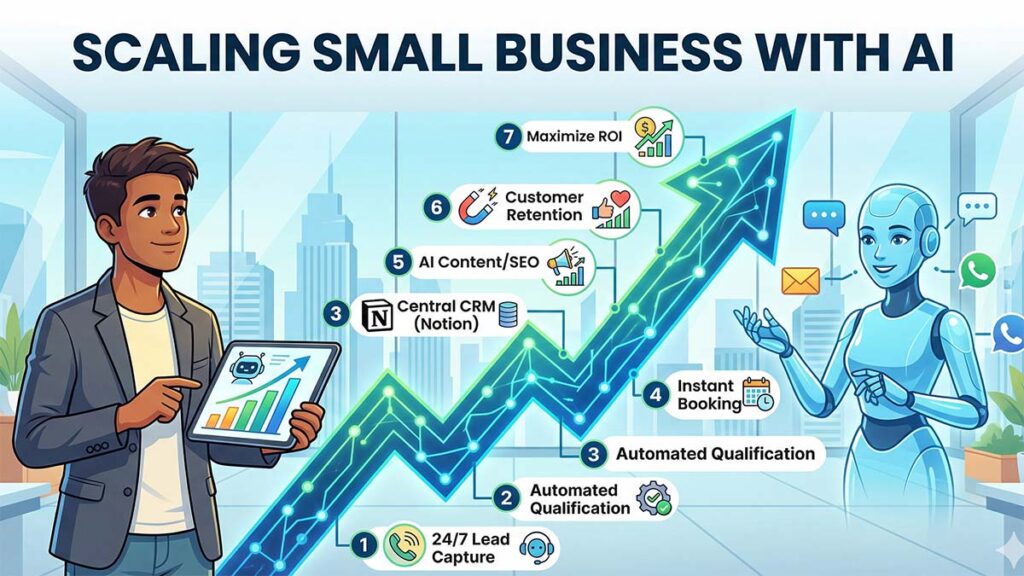
In the hyper-accelerated market of 2026, the traditional “hire to grow” model is dead. For lean startups and solo founders, the goal is no longer to build a large team, but to construct a “human-less business ecosystem.” This Scaling Small Business with AI guide provides a strategic blueprint for using automation as your primary growth lever. By replacing manual bottlenecks with intelligent agents, you can achieve the output of a 50-person firm with a fraction of the overhead.
The Shift to an Agentic Infrastructure
Scaling is often misunderstood as a linear progression of resources. In reality, scaling is about increasing the gap between your revenue and your operational complexity. This Scaling Small Business with AI strategy centers on “Agentic AI”—systems that don’t just follow rules but execute goals. Whether you are managing a solar energy agency or a technical consultancy, your infrastructure must be autonomous to be truly scalable.
1. 24/7 Lead Capture and Instant Response
The first pillar of Scaling Small Business with AI is ensuring you never miss an opportunity. A human receptionist is limited by time zones and biological needs; an AI receptionist is not. By deploying a “Caring” AI persona (like those built at VPI Concepts), you ensure that every potential lead is greeted within seconds, qualified immediately, and moved into your sales pipeline. This instant gratification is the difference between a conversion and a lost prospect in a world with zero attention span.
2. Automated Lead Qualification and Triage
If you are manually sorting through contact forms, you are not scaling; you are babysitting data. An effective Scaling Small Business with AI workflow uses logic-based AI to “triage” leads.
- High-Intent Leads: Automatically booked into your calendar.
- Informational Queries: Directed to a dynamic FAQ or Notion database.
- Disqualified Leads: Politely archived with an automated referral link.
3. The n8n and Notion “Second Brain”
To scale, your business needs a central nervous system. Using n8n to bridge your AI agents with a Notion Second Brain creates a “Zero-Entry” environment. Every call transcript, every customer preference, and every financial transaction should flow into your database automatically. This allows you to manage multiple business lines—from AI receptionists to solar installations—from a single, unified dashboard without needing a project manager.
| Feature | Traditional Scaling | AI-Driven Scaling (2026) |
| Recruitment | Slow/Expensive | Instant/Scalable |
| Data Entry | Manual/Prone to Error | 100% Automated |
| Response Time | Hours/Days | < 500ms |
| Operational ROI | Linear | Exponential |
4. High-Velocity Content and SEO
Marketing is often the hardest department to scale without humans. However, this Scaling Small Business with AI guide recommends a “systemized” approach to SEO. By using AI to analyze search trends and generate high-quality, long-form content that meets specific Rank Math requirements, you can dominate your niche’s search results. The secret is to keep the “Human-in-the-loop” only for the final strategic edit, letting AI handle the heavy lifting of research and formatting.
5. Horizontal Scaling Across Industries
One of the most powerful aspects of Scaling Small Business with AI is the ability to clone your success. Once you have a working automation stack (e.g., n8n + Notion + Voice AI), you can apply it to entirely different industries. A founder in Lahore can simultaneously run a branding agency, a solar company, and an AI startup because the underlying systems are identical. You are not scaling a business; you are scaling a framework.
6. Proactive Customer Retention
Scaling isn’t just about getting new customers; it’s about keeping them. Use AI to monitor “customer health” by analyzing communication frequency and sentiment. An automated system can trigger a “Checking-in” email or a discount code if it detects a drop in engagement. This proactive retention strategy prevents the “leaky bucket” syndrome that often kills small businesses during growth spurts.
7. Financial ROI and Cost Optimization
In 2026, your biggest expense should be your API calls, not your payroll. This Scaling Small Business with AI guide emphasizes aggressive cost optimization. By replacing a $3,000/month human receptionist with a $150/month AI system, you immediately recapture $34,200 in annual profit per role. That capital can then be reinvested into paid traffic or R&D, creating a compounding growth loop.
Implementation Checklist
- Audit Your Bottlenecks: Where is a human doing a “repetitive” task?
- Deploy Your Front Desk: Set up a VPI Concepts-style AI receptionist for 24/7 intake.
- Sync Your Data: Use n8n to connect your front-end to your Notion CRM.
- Internal Link: Review our [AI Front Desk Automation Workflow Guide] for technical setup.
- External Link: View the World Economic Forum 2026 AI Growth Report for global trends.
Conclusion
Scaling Small Business with AI is the only way to remain competitive in a landscape where speed is the ultimate currency. By building a human-less business ecosystem, you remove the limits of human latency and payroll fatigue. Focus on your systems, and the growth will follow.
